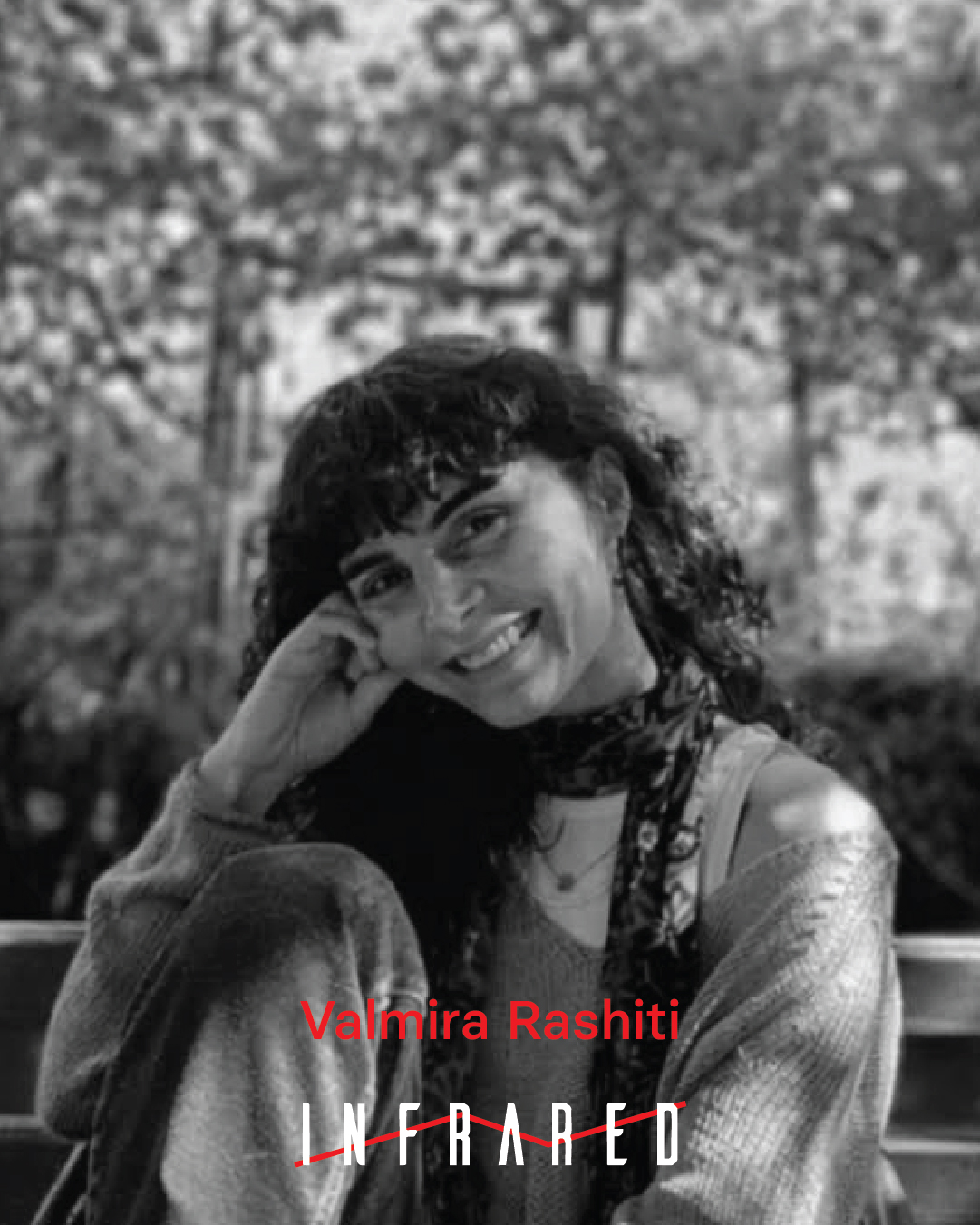
Valmira Rashiti is a researcher, writer, and editor from Kosovo, with a focus on gender, sociological, and anthropological research. Over the years, her work has explored the relationships between gender, class, collective memory, social transformations, and overlooked aspects of everyday life in Kosovo, with a particular interest in how political, economic, and cultural structures shape intimate and collective lives.
Since 2018, her research engagement has been closely intertwined with feminist activism, through authoring studies, essays, and lectures on gender and sexual identity in Kosovo.
Through her work, Valmira aims to contribute to building a critical language—one that remains sensitive to differences—to better understand not only forms of inequality and exclusion, but also the ways in which personal, ecological, and social experiences are deeply interconnected. This approach has guided her toward modes of thinking that view nature not as a passive landscape for observation, but as an active ecosystem that continuously interacts with human life.
Valmira has contributed to the development of editorial content and is also the author of writings that reflect her critical approach to ecological awareness. In this context, her project within INFRARED Residency, “The Trees’ Curse Will Catch You,” emerges from a reflection on the relationship between humans and nature.
“Ahti” is a concept rooted in the collective memory of Albanians, referring to a moral curse that arises when a grave injustice is committed against a being or a symbolically sacred value. In folk narratives, oak trees and old trees are often seen as carriers of community memory—places where gatherings were held or rituals took place. Therefore, their cutting or damage has not only been understood as a physical act against nature, but also as a disruption of a symbolic order. In this sense, the phrase “the trees’ curse will catch you” has been passed down through generations, often as a warning.
This research project seeks to further explore this phrase by investigating “ahti” as an early form of ecological consciousness. At a time when urban and rural spaces in Kosovo are rapidly transforming, and old trees are often removed to make way for construction and infrastructure, the project reintroduces people to the notion of “ahti,” confronting them with the question: what happens when humans lose their sense of harmony with nature?